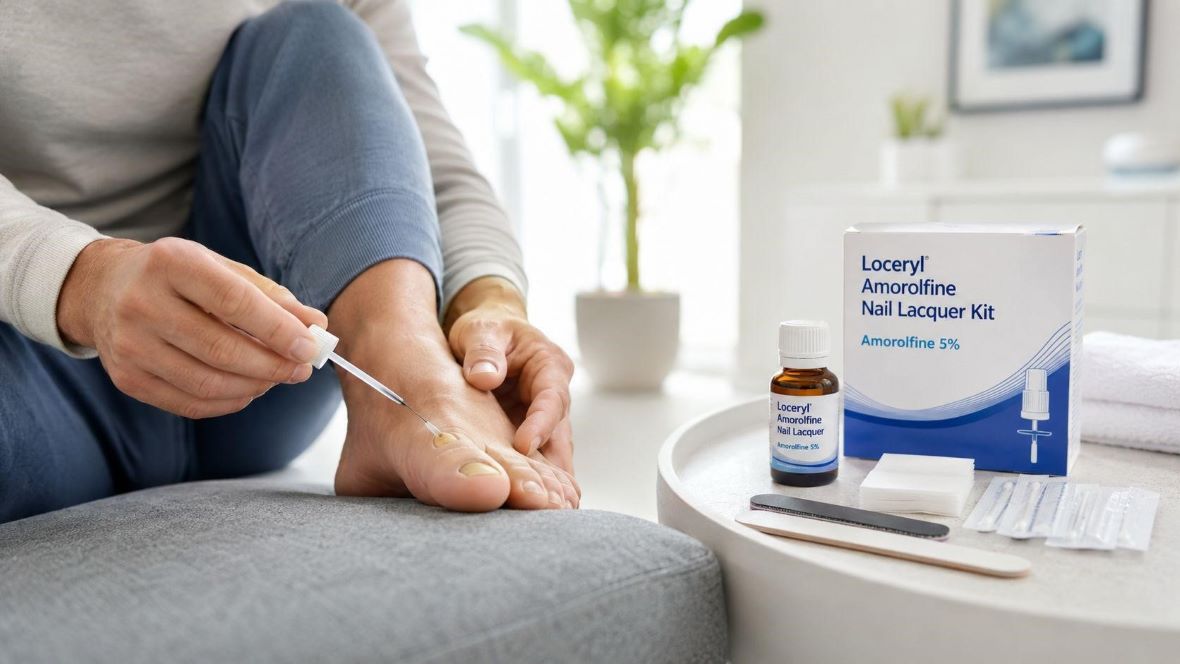
A fungal toenail can look like a minor cosmetic problem at first.
Perhaps one corner of the nail turns yellow. The surface becomes rougher. The nail gets thicker, starts breaking more easily, or develops material underneath it. Months later, the discoloration may have spread across much of the nail.
This slow progression is typical of onychomycosis, the medical term for fungal nail infection.
And unfortunately, simply cutting away the discolored part usually does not solve the problem. The fungi can persist inside and underneath the nail plate, while the slow growth of nails means that even successful treatment may take months before the visible damage disappears.
That is exactly the challenge that amorolfine nail paint is designed to address.
Rather than treating the surrounding skin like an ordinary antifungal cream, amorolfine is formulated as a medicated lacquer that remains on the nail and allows an antifungal medicine to penetrate through the hard nail plate.
Skin is relatively accessible to topical medicines. Nails are different.
The nail plate is made primarily from tightly packed keratin. It is designed to be tough and protective, which is useful biologically but inconvenient when medication needs to reach fungi living underneath it.
A standard antifungal skin cream may work well for athlete's foot but is generally not designed to penetrate a thick nail plate effectively.
That is why fungal nail infections have their own formulations.
With an amorolfine nail paint, the liquid is spread directly over the infected nail. After the solvent evaporates, the medication remains in contact with the nail surface and progressively penetrates into the nail.
Official Loceryl product information states that amorolfine diffuses through the nail plate and can reach fungi located in the nail bed while producing very low systemic absorption.
This local action is one reason medicated nail lacquer can be attractive for appropriately selected fungal nail infections.
Amorolfine is a topical antifungal medicine.
It works by interfering with the production of sterols used to construct the fungal cell membrane.
One especially important fungal sterol is ergosterol.
When amorolfine disrupts the enzymes involved in fungal sterol synthesis, normal membrane composition is disturbed. This interferes with the organism's ability to maintain a functional cell membrane and ultimately inhibits or kills susceptible fungi.
Amorolfine has activity against several types of organisms known to cause nail infections, including dermatophytes, yeasts and certain moulds.
That matters because not every fungal nail infection is caused by exactly the same organism.
Loceryl is a medicated nail lacquer containing 5% w/v amorolfine, supplied as amorolfine hydrochloride.
It is manufactured under the Galderma brand and has been used internationally for fungal nail infections.
The lacquer format is important. Instead of applying a conventional cream around the nail, the user coats the affected nail itself.
Consumers researching the formulation, kit components and availability can review the Loceryl Amorolfine Nail Lacquer Kit here.
Depending on the specific pack configuration, Loceryl kits can contain the medicated lacquer together with accessories such as cleaning swabs, applicators and nail files intended to help prepare the infected nail before treatment.
That preparation is more important than it might initially appear.
One of the distinctive features of amorolfine treatment is that simply painting the lacquer onto an untouched infected nail is not the complete process.
Before the first application, official Loceryl instructions recommend filing down the affected areas of the nail, particularly the nail surface.
Why?
A fungal nail may become unusually thick and irregular. Removing some of the abnormal material reduces the physical barrier between the medicine and the infected parts of the nail.
The nail is then cleaned and degreased before the lacquer is applied.
With subsequent applications, remaining lacquer is removed as directed, the affected nail is filed again where necessary, and the surface is cleaned before the fresh coat is applied.
There is also an important hygiene rule:
A nail file used on an infected nail should not subsequently be used on healthy nails.
Otherwise, a grooming tool intended to help treatment could theoretically contribute to spreading fungal material.
Perhaps the most surprising thing about Loceryl is the contrast between its application frequency and its overall treatment duration.
Official product information recommends applying Loceryl to affected fingernails or toenails once weekly, noting that twice-weekly application may be beneficial in some cases.
That schedule sounds relatively simple.
The challenge is staying consistent for long enough.
Typical treatment duration is approximately:
This is not because amorolfine takes a year to begin acting against fungi.
The problem is nail growth.
A damaged nail does not instantly transform into a clear, healthy nail when fungal activity is controlled. The infected portion must gradually move outward as healthy nail grows from the base.
Toenails grow particularly slowly.
So progress is often best judged by looking near the cuticle. A widening area of normal-looking nail growing from the base can be more meaningful than staring at the old damaged section at the tip.
This simple change in expectations can make fungal nail treatment much less frustrating.
Imagine an infected toenail where half the nail is yellow and thickened.
Even if treatment successfully controls the fungus, the discolored half does not necessarily become transparent again.
Instead, healthier nail begins growing behind it.
Over the following months, the boundary between normal and damaged nail gradually moves toward the tip. The abnormal portion can then be trimmed away as growth continues.
This explains why abandoning treatment after three or four weeks because the nail still looks discolored can be misleading.
Nails operate on a much slower biological timetable than skin.
No—and this is an important point before starting months of antifungal treatment.
Several conditions can resemble nail fungus.
For example:
Dermatologists may therefore examine nail clippings or material taken from underneath the nail when the diagnosis is uncertain.
If someone treats a non-fungal nail disorder with antifungal lacquer for nine months, the lack of improvement is hardly surprising.
This is particularly important when several nails are severely affected or when the appearance is unusual.
Topical antifungal therapy tends to make the most sense when fungal involvement is relatively limited.
A lacquer may be particularly attractive when only one or a few nails are involved and the infection has not extensively damaged the nail-producing area near the base.
More extensive onychomycosis may require a different strategy.
Dermatologists sometimes prescribe oral antifungal medicines when infection is widespread, severe, very thick or difficult for topical medicine to reach.
Oral therapy can be more effective for certain infections because the medication reaches the nail through the bloodstream as the nail grows.
But systemic medicines also introduce additional considerations, including potential drug interactions and, with some antifungal drugs, the need to consider liver function.
That is why the “strongest” treatment is not automatically the best treatment for every person.
Treatment should match the extent and characteristics of the infection.
Someone treating toenail fungus should also look carefully at the skin between and around the toes.
Fungal nail infection and tinea pedis, better known as athlete's foot, frequently occur together.
This matters because untreated fungal infection on the surrounding skin can provide a continuing reservoir of fungi.
Official Loceryl information specifically advises treating co-existing tinea pedis with an appropriate antifungal preparation.
In practical terms, treating the nail while continually ignoring fungal skin infection may undermine efforts to keep the feet clear.
Medication is only one part of managing recurrent nail fungus.
Fungi thrive in warm, damp environments, so several everyday habits can help reduce repeated exposure.
Keeping feet dry, changing socks regularly and allowing footwear to dry thoroughly between uses are sensible steps.
Avoid sharing nail clippers or files.
Wear footwear in communal showers, pool areas and changing rooms.
If nail-grooming instruments are reused, they should be appropriately cleaned.
Shoes that repeatedly create pressure or trauma against a toenail can also contribute to nail damage, making the nail more vulnerable.
None of these measures substitutes for antifungal treatment, but they address the environment in which reinfection can occur.
Modern official Loceryl instructions allow cosmetic nail varnish to be applied after the medicated lacquer has dried, with a recommended interval of at least 10 minutes.
However, cosmetic varnish must be carefully removed before the next treatment application so that the infected nail can again be cleaned and prepared.
Artificial nails should not be used during treatment.
People should also remember that covering an abnormal nail cosmetically can make it harder to monitor whether healthy nail is actually growing from the base.
Because systemic absorption of topical amorolfine is very low, whole-body exposure is limited.
Nevertheless, topical medicines can still cause adverse reactions.
Official prescribing information reports rare nail effects such as:
Very rare burning sensations have also been reported, while post-marketing reports include redness, itching, contact dermatitis, hives and blistering.
Some of these nail abnormalities can also be caused by the fungal infection itself, making the source difficult to distinguish.
Allergic reactions are possible and can occasionally be serious.
Anyone experiencing facial swelling, breathing difficulty or a severe reaction should stop using the product and seek medical assistance.
The lacquer should also be kept away from the eyes, mouth, ears and surrounding skin.
Official Loceryl information states that experience with topical amorolfine during pregnancy and breastfeeding is limited.
For that reason, amorolfine should not be used during pregnancy or lactation unless a healthcare professional considers it clearly necessary.
Consumers should not assume that topical automatically means suitable during pregnancy.
Self-management becomes less appropriate when the problem is extensive or complicated.
Medical assessment is particularly sensible when:
People with diabetes should be especially careful about foot problems because relatively minor injuries and infections can become more consequential when sensation or circulation is impaired.
There is something unusual about treating nail fungus.
The medicine may be applied in minutes, but success is measured in months.
That makes adherence particularly important.
An amorolfine nail paint such as Loceryl offers a targeted way to deliver antifungal medication into an infected nail while minimizing systemic exposure. Its once-weekly schedule can make long-term treatment relatively manageable.
But no lacquer can accelerate the natural growth rate of a toenail dramatically.
The visible evidence of success is usually not the old damaged nail suddenly becoming perfect. It is the slow appearance of cleaner, healthier nail emerging from the base.
That means the most realistic strategy combines correct diagnosis, careful nail preparation, regular application, good foot hygiene and enough patience for the nail to replace itself.
For a condition famous for being stubborn, that consistency can be just as important as the medicine inside the bottle

This post has been published by the admin of our website, responsible for content management, quality checks, and providing valuable information to our users.