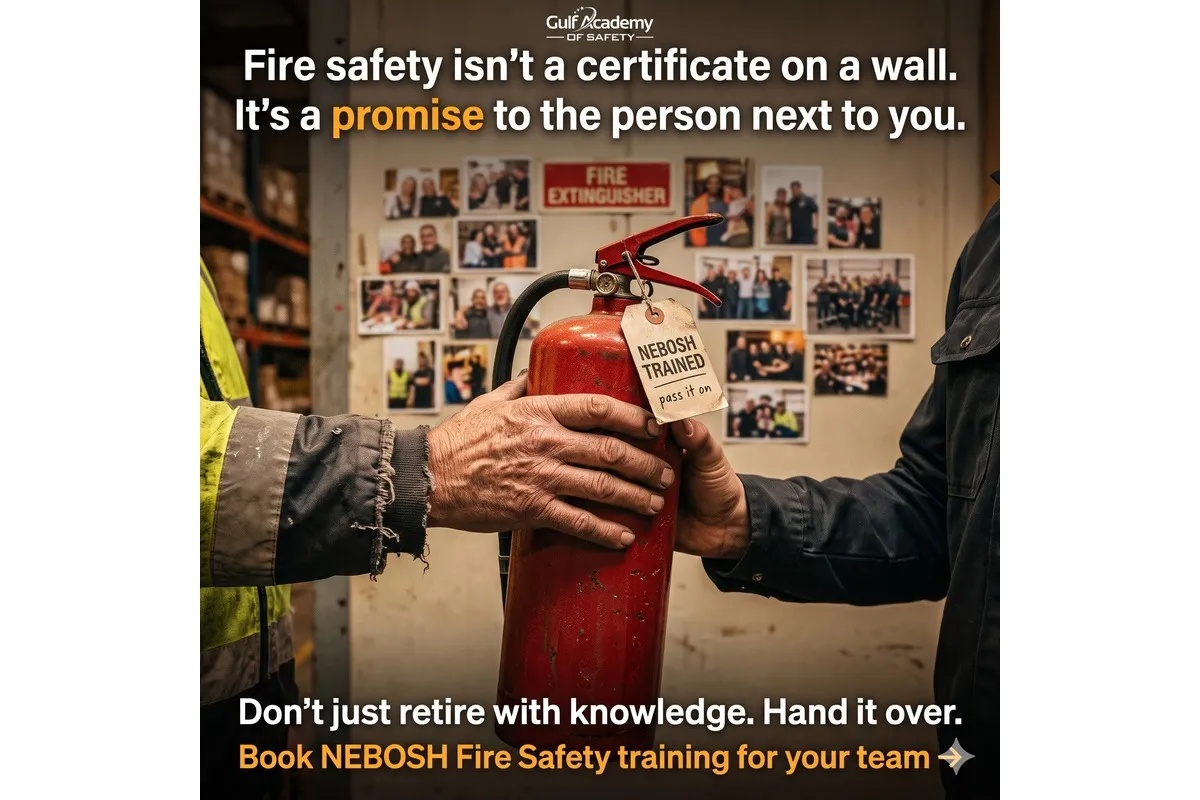
Every building has a fire plan. Far fewer have someone who truly understands it. That gap is where careers are made, and it is why the NEBOSH Fire Certificate has become a popular route for people who want to move into fire safety with a recognised qualification behind them.
Why fire safety skills are in demand
Fire is one of the few workplace hazards that can turn a small mistake into a total loss in minutes. People are hurt, assets are destroyed, operations stop, and legal trouble follows. Employers know this, so they look for people who can spot fire risks early and show they have a plan.
Laws and insurance requirements in many countries expect organisations to manage fire risk through a competent person. A formal qualification is one of the clearest ways to show you are that person.
That is the space the NEBOSH Fire Safety Certificate occupies. It gives learners a structured, internationally recognised grounding in managing fire risk, and a credential employers already understand.
Who is it for?
You do not need a safety background. According to Gulf Academy Safety, the course suits:
- Fire marshals and fire wardens who want to formalise what they already know, particularly in low-to-medium risk workplaces
- Facilities managers and health and safety representatives who want in-house fire expertise on their team
- Supervisors and managers who carry legal responsibility for fire compliance
- Career changers looking for a specialised, practical entry point into safety work
If you are thinking, “I do not have a safety degree,” that is fine. There are no formal entry requirements. What matters is solid English, and an IELTS level of around 6.0 is recommended.
What you actually learn
The NEBOSH Certificate in Fire Safety is built around practical skills rather than theory for its own sake. It runs through six areas: managing fire safety and legal duties, the principles of fire and explosion, fuel, oxygen and ignition sources, fire protection in buildings, the safety of people if a fire happens, and fire safety risk assessment.
In plain terms, you learn why fires start, how they spread, how buildings are designed to slow them down, how people get out safely, and how to assess a workplace and recommend improvements. The last skill, risk assessment, is the one employers tend to value most.
There is also no heavy maths. The course focuses on principles, judgement, and compliance.
Structure and time commitment
The qualification is a Level 3 Vocational Related Qualification, often compared in level to an A-Level. Plan for about 60 hours in total, including at least 28 taught hours and roughly 20 hours of private study.
Delivery can be flexible. Classroom or virtual study usually runs as five days of intensive instruction and assessment, while online and distance learning lets you work at your own pace, with access for up to a year.
How you are assessed
Two units must both be passed:
- FSC1 is a 24-hour, scenario-based open book examination taken remotely. You are given a realistic situation and asked to apply your knowledge to it. It tests judgement and application rather than memorisation.
- FSC2 is a practical fire risk assessment carried out in a real workplace. You identify hazards, assess the risk, and recommend control measures, using recognised guidance such as PAS 79-1:2020.
Both are marked externally by NEBOSH examiners. FSC2 is where many learners say the course comes alive, because you stop reading about fire risk and start doing the job.
Why employers care
Recruiters do not have time to test every candidate’s fire knowledge in depth. A NEBOSH Fire Safety qualification works as a shortcut: it signals that you have been trained to a recognised standard and assessed by an independent body.
It also proves something that is hard to put on a CV otherwise, that you can carry out a practical fire risk assessment, not only describe one.
Where it can lead
Gulf Academy Safety lists a range of roles open to certificate holders, including fire safety risk assessor or consultant, fire safety advisor or officer, fire safety technical manager, fire safety manager, and SHEQ or safety manager roles with a fire focus. The salary figures it quotes are UK ranges, from around £28,500–£40,000 or more for regional risk assessor roles to £50,000–£60,000 for London-based roles and managers. Pay varies by region, employer, and experience, so treat these as indicative.
You can also use the certificate as a stepping stone. Many learners continue to the NEBOSH General Certificate, the International Diploma, or specialist routes such as Process Safety Management.
Choosing a provider
Because the syllabus is the same everywhere, the difference is in the teaching and support. Look for experienced tutors, flexible schedules, and help with both assessments, especially the practical. Gulf Academy Safety describes itself as a NEBOSH Gold Learning Partner and offers classroom, online, and e-learning options across the Middle East and India.
A simple way to decide
Ask yourself three questions:
- Do I want a recognised credential that proves I can manage fire risk?
- Do I prefer practical, scenario-based learning to memorising facts?
- Can I commit to roughly 60 hours of focused study?
If the answer to all three is yes, this qualification is worth a serious look.
Take the next step
Fire safety is a field where good people are hard to find and easy to value. A recognised qualification gets you into the conversation. What you do next is up to you.
👉 Explore the NEBOSH Fire Certificate with Gulf Academy Safety and start building your fire safety career.