Sensitive and sensitized skin presents a complex challenge in contemporary dermatology. When the epidermal shield is impaired, the cutaneous nervous system becomes hyper-reactive, manifesting as sudden flushing, stinging sensations, transient erythema, and acute intolerance to environmental changes. For individuals managing reactive complexions, standard facial treatments can often induce more distress than relief. Many commercial formulations rely on synthetic fragrances, harsh penetrative solvents, and aggressive biological concentrates that overwhelm an already vulnerable stratum corneum.
Korean cosmetic science approaches sensitive skin care through the dual concepts of Jeobageuk (minimal mechanical irritation) and Skin Barrier Restorative Engineering. Instead of forcing reactive tissue to process high percentages of destabilizing actives, K-Beauty formulations focus on biomimetic lipid re-assembly, thermal cooling, and anti-inflammatory botanical complexes. By deploying a specialized korean face mask for sensitive skin, you can deliver targeted, calming relief while reinforcing structural defenses against future irritation.
What pathophysiological factors trigger sensitive skin reactivity?
Formulating for sensitive skin requires understanding the microscopic failures that occur within a compromised epidermal barrier. Cutaneous sensitivity is rarely an isolated aesthetic inconvenience; it is a clinical state driven by structural and neuro-sensory vulnerabilities.
How does structural lipid depletion lead to neuro-sensory irritation?
The outermost layer of the epidermis, the stratum corneum, functions as a brick-and-mortar wall where corneocytes represent the bricks and intercellular lipids (ceramides, cholesterol, and free fatty acids) act as the mortar. When this lipid matrix degrades due to environmental stress, genetics, or harsh cleansing, microscopic fissures develop throughout the surface.
This structural breakdown triggers a two-way cascade:
- Transepidermal Water Loss (TEWL): Vital hydration evaporates rapidly into ambient air, leaving skin parched and brittle.
- Irritant Permeation: Atmospheric micro-pollutants, chemical allergens, and micro-organisms penetrate freely into the deeper viable epidermis.
Once these external agents reach living tissue, they encounter cutaneous sensory nerve fibers (unmyelinated C-fibers) and trigger local immune mast cells. This interaction causes the release of substance P and histamine, producing the familiar sensations of burning, itching, and tight discomfort.
Why does cutaneous heat retention escalate inflammatory redness?
Sensitive skin frequently suffers from impaired thermal regulation. Localized micro-inflammation dilates superficial dermal capillary beds, trapping heat within the facial tissue. This elevated cutaneous temperature accelerates the breakdown of collagen, promotes the overgrowth of opportunistic skin bacteria, and worsens chronic conditions such as rosacea. Effective calming treatments must actively dissipate this surface heat to break the cycle of persistent facial flushing.
Which calming botanicals and actives quiet reactive flare-ups?
K-Beauty formulations rely on a curated spectrum of biocompatible botanicals that possess clinical validation for suppressing pro-inflammatory cytokines while supporting natural cellular repair.
How do isolated Centella Asiatica compounds rebuild cellular cohesion?
While raw Centella Asiatica extract is a staple across Asian medicine, advanced Korean formulations utilize purified, isolated triterpenoids: madecassoside, asiaticoside, madecassic acid, and asiatic acid. Madecassoside works at a cellular level to inhibit the expression of nuclear factor-kappa B (NF-κB), a primary transcription factor responsible for inflammatory cytokine production. Concurrently, asiaticoside signals fibroblasts to accelerate normal collagen synthesis, rebuilding damaged tissue without triggering reactive flare-ups.
What makes Heartleaf (Houttuynia Cordata) effective for reactive flushing?
Houttuynia Cordata, or Heartleaf, is particularly suited for skin prone to sudden heat and blotchiness. The plant is rich in bioactive polyphenolic flavonoids, notably quercetin and quercitrin. These natural compounds act as vascular stabilizers and anti-inflammatory agents, reducing capillary permeability to calm the appearance of visible redness. Furthermore, heartleaf possesses natural antimicrobial properties that gently balance the surface microbiome without stripping beneficial skin flora.
Why is Panthenol (Pro-Vitamin B5) an indispensable structural stabilizer?
Panthenol is a gold-standard therapeutic agent for barrier restoration. As a small, water-soluble molecule, it penetrates the stratum corneum and converts enzymatically into pantothenic acid (an essential component of Coenzyme A). In this form, it plays a vital role in cellular energy production and the natural synthesis of epidermal lipids. Beyond its ability to bind free water molecules, panthenol speeds up re-epithelialization, soothing itchy, uncomfortable sensations while reinforcing the skin’s baseline defenses.
Why does carrier fabric engineering matter for easily irritated complexions?
When choosing a korean skincare face mask for reactive skin, the physical carrier is just as critical as the essence it holds. For sensitized tissue, physical friction from coarse fibers can trigger micro-trauma, causing inflammation before the formula has a chance to absorb.
How do ultra-smooth fibers reduce mechanical micro-friction?
Standard coarse cotton or low-grade non-woven synthetic fabrics often feature irregular, jagged microscopic profiles that rub against compromised skin, provoking mechanical contact dermatitis. Top-tier Korean sheet masks for sensitive skin utilize refined carrier fabrics engineered for minimal surface friction:
- 100% Unbleached Pure Cotton: Free from chemical bleaching agents, fluorescent brighteners, and toxic binding glues, pure cotton provides a soft, breathable cushion over delicate skin.
- Lyocell and Tencel Fibers: Manufactured from sustainable eucalyptus wood pulp through closed-loop solvent spinning, these fibers possess an exceptionally smooth, uniform surface that glides over raised or irritated tissue without snagging.
- Fermented Bio-Cellulose: Grown through the bacterial fermentation of coconut water, bio-cellulose fibers are roughly one-thousandth the thickness of human hair. This creates a flexible, gelatinous sheet that molds closely to facial curves, minimizing air pockets and mechanical movement against the skin.
How do cooling hydrogels reduce thermal sensitivity?
For skin suffering from acute heat retention, sunburn, or post-laser sensitivity, synthetic polymer hydrogels offer significant therapeutic advantages. Because hydrogels consist of cross-linked water-soluble biopolymers, they act as thermodynamic heat sinks. A hydrogel mask naturally absorbs and dissipates facial heat, reducing cutaneous surface temperature by 3°C to 5°C throughout its wear time without the shock of refrigeration. This steady cooling effect constricts dilated capillaries, reduces swelling, and quiets burning sensations.
What ingredients and irritants should be strictly excluded?
Formulating for sensitized complexions is largely an exercise in deliberate exclusion. A high-performing calming mask must eliminate common cosmetic triggers that could provoke an adverse immune response.
| Formulation Hazard | Biological Impact on Sensitive Skin | Formulator Alternative |
| Synthetic Fragrance & Dyes | High-affinity skin sensitizers; frequent cause of allergic contact dermatitis | Completely fragrance-free; zero aromatic additives |
| Volatile Drying Alcohols | Dissolves intercellular lipids, leaving microscopic gaps in the barrier | Purified water, botanical distillates, fatty alcohols |
| Essential Oils (e.g., Citrus, Mint) | Contains volatile terpenes (limonene, linalool) that oxidize into strong allergens | Purified botanical fractions (Madecassoside, Allantoin) |
| Aggressive Penetration Enhancers | Disables natural barrier resistance to force rapid active absorption | Slow-release, physiological lipid micro-emulsions |
When assessing a formula, look for certifications indicating dermatological safety, such as verified human patch testing (HRIPT) or the German DermaTest "Excellent" rating, which confirm that the formula is non-sensitizing and suitable for reactive complexions.
How should you safely integrate a korean skin care mask into a calming routine?
Applying a facial treatment to sensitive skin requires careful handling to prevent overwhelming the skin barrier. Follow this structured approach to ensure maximum therapeutic benefit:
- Conduct a Pre-Application Patch Test: Before placing any new sheet over your entire face, snip a small corner of the mask packaging and apply a droplet of the serum behind your earlobe or along the inner jawline. Monitor the area for fifteen minutes to verify that there is no burning, itching, or hives.
- Prep with a Gentle, Low-pH Barrier: Cleanse with a mild, surfactant-sparing lotion formulated around pH 5.5. Avoid steaming the face or using warm washcloths, as elevated water temperatures induce vasodilation and irritate reactive skin.
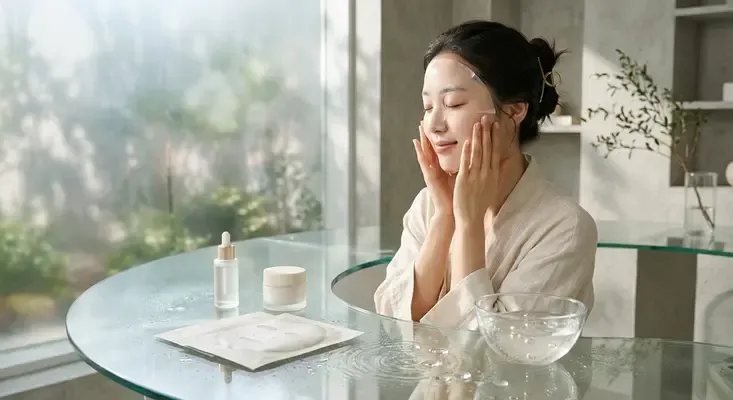
- Apply with Minimal Friction: Unfold your chosen korean face mask for sensitive skin gently, smoothing it outward from the center of the face without stretching the fabric. Smooth away air pockets using light fingertip pressure to avoid friction against sensitized areas.
- Observe the Removal Threshold: Never leave a sheet mask on until it dries. Limit wear time to 10 to 15 minutes, removing the fabric while it is still thoroughly wet to prevent capillary back-absorption from pulling moisture out of the stratum corneum.
- Seal with Biomimetic Lipids: Gently pat the remaining essence into the skin without vigorous rubbing. Immediately follow with a barrier-repair moisturizer containing ceramides, squalane, and cholesterol to lock in the soothing humectants and establish an enduring protective shield over your calm, balanced complexion.