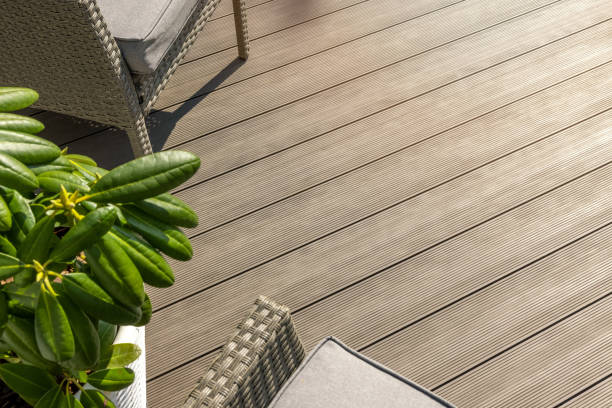
Outdoor surfaces in the capital face a punishing combination of coastal humidity, salt carried on the sea breeze, and months of direct sun. Natural timber rarely survives it gracefully. WPC flooring Abu Dhabi homeowners choose instead blends wood fibre with polymer to give the warmth and grain of real wood in a board that does not rot, splinter or need annual sealing. This guide covers the practical benefits, realistic price bands and the applications where the material performs best, with product guidance from Floorna.
Coastal exposure is the variable most people underestimate. Salt-laden air accelerates corrosion on fixings and degrades untreated timber far faster than it does inland. Capped boards, which carry a protective polymer shell over the composite core, hold their colour and resist staining noticeably better in these conditions than uncapped alternatives. Reviewing the full WPC Flooring range makes the difference between profiles easier to see.
Lighter tones and textured faces absorb less radiant heat than dark, dense materials, which keeps a terrace usable in the early evening rather than radiating stored warmth long after sunset.
There is no sanding, staining or annual oiling. A wash down with mild detergent and a soft brush clears sand and salt residue, which is the entire maintenance routine for most residential installations.
The polymer content means the board does not absorb water the way timber does, so it resists swelling, warping and the mould growth that plagues untreated wood near pools and coastal frontages.
Board supply typically ranges from around AED 90 per square metre for entry level hollow profiles up to AED 250 and above for capped solid boards with a deeper texture. Solid profiles cost more because they use more material, but they feel firmer underfoot and handle heavy furniture better. Installation usually adds AED 40 to AED 90 per square metre, and that figure depends heavily on the substructure. A joist system over an uneven roof slab costs more than a straightforward laydown on a level, drained terrace. Clips, trims, edging and fascia boards are normally quoted separately, so ask for a full itemised breakdown rather than a rate per square metre alone. Comparing capped and uncapped options within the WPC flooring Abu Dhabi collection is the fastest way to understand where the price difference actually sits.
Large terraces suit wide solid boards laid along the longest sightline. The continuous run reads as a deliberate architectural surface rather than a patchwork, and solid profiles cope with dining furniture being dragged across them.
Weight and drainage matter more than anything else up high. Hollow profiles reduce load, and the substructure must maintain the existing fall toward the drain. Many towers also require a fully removable system, so confirm the building rules before ordering.
Slip resistance and cool underfoot performance are the priorities here. A ribbed or brushed surface gives grip when wet, and light tones keep the deck comfortable for bare feet during peak summer.
The right board is the one matched to the exposure, the substructure and the way the space is actually used. Choose a capped profile for coastal frontages, keep tones light where bare feet are involved, and treat the substructure as part of the product rather than an afterthought. For a wider view of composite decking across the Emirates, the WPC decking in Dubai overview and the outdoor WPC flooring guide both cover profile selection in more depth, and the team can advise on the WPC flooring Abu Dhabi specification that suits your terrace, budget and timeline.

This post has been published by the admin of our website, responsible for content management, quality checks, and providing valuable information to our users.