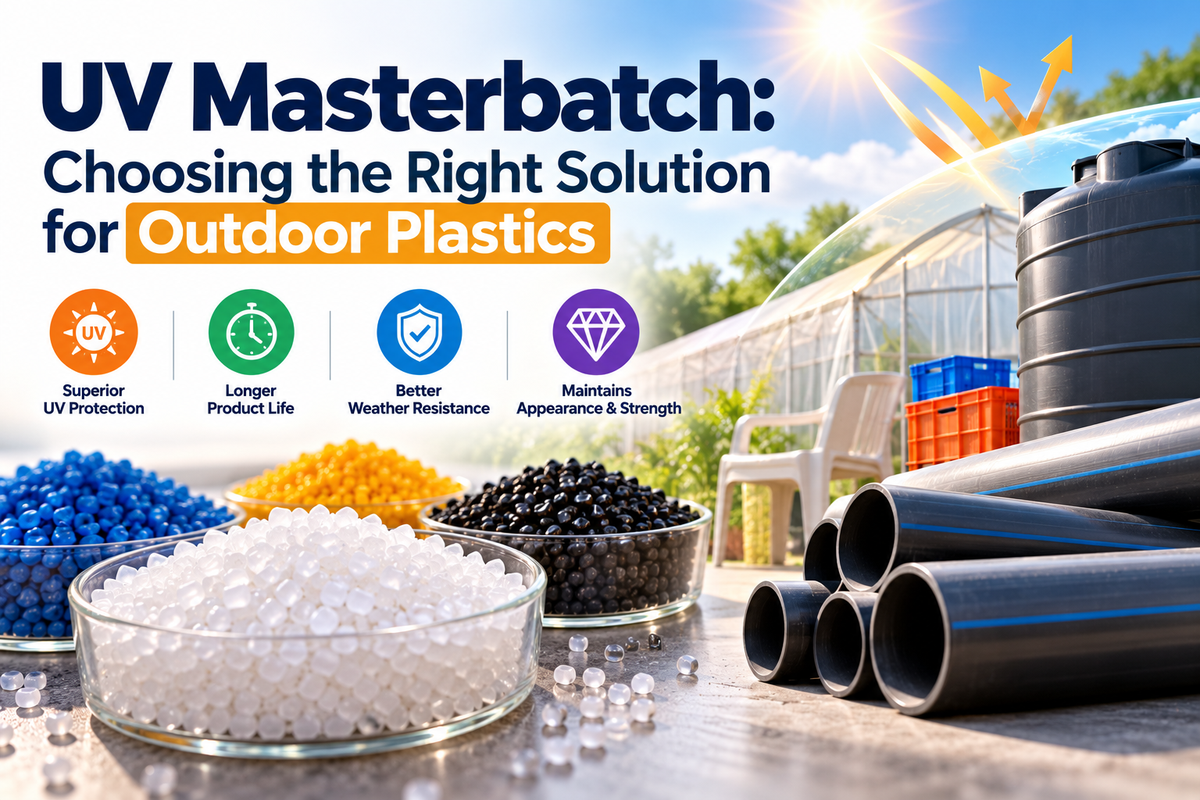
Outdoor plastic products face continuous exposure to sunlight, heat, moisture, and changing weather conditions. Ultraviolet radiation is one factor that can accelerate polymer degradation. For manufacturers, choosing the right UV protection system improves the service performance of outdoor products. UV masterbatch provides a practical way to introduce UV-stabilising additives into a polymer formulation while maintaining controlled dosing during production.
For businesses comparing plastic master batch manufacturers in India, the key issue is not simply finding a concentrate labelled “UV masterbatch”. The formulation needs to match the polymer, processing method and expected exposure conditions.
Sunlight contains ultraviolet radiation that can trigger chemical changes in susceptible polymers. Depending on the polymer and exposure conditions, degradation can lead to colour changes, surface cracking, loss of mechanical properties and reduced service life.
The risk varies with:
• Polymer chemistry
• UV exposure
• Product thickness
• Outdoor temperature
• Pigments and additives
• Product geometry
• Expected service period
A plastic component used indoors does not face the same UV stress as an agricultural film, outdoor furniture component or exposed infrastructure product.
UV masterbatch is a concentrated formulation containing UV stabilisers or related protective additives dispersed in a carrier resin.
Instead of adding a small quantity of active additive directly to a large polymer batch, processors use a concentrated masterbatch. This improves handling and supports controlled addition during production.
The concentrate should disperse evenly through the base polymer. Poor dispersion creates inconsistent protection and can affect product appearance.
UV radiation can contribute to polymer-chain degradation. The visible effects depend on the material and environment.
A product may show:
• Fading or colour change
• Surface embrittlement
• Cracking
• Loss of tensile performance
• Reduced impact resistance
• Changes in surface appearance
UV stabilisation works alongside the base polymer's inherent resistance. It does not eliminate all environmental ageing.
UV masterbatch is used in a wide range of plastic products.
Agricultural films
Films used in agriculture often remain outdoors for extended periods. Their formulation must consider UV exposure, thickness, temperature and other additives.
Outdoor containers
Plastic tanks, bins and containers exposed to sunlight need appropriate stabilisation based on their expected use.
Pipes and profiles
Certain outdoor pipes, sheets and profiles require protection against long-term environmental exposure.
Automotive and industrial components
Exterior components face sunlight and temperature changes. The required stabilisation system depends on the polymer and design.
Start with the polymer.
A UV formulation suitable for one polymer should not automatically be transferred to another. The carrier and additive package need to work with the base resin.
Next, consider exposure.
Ask how many hours of direct sunlight the product receives, whether it is exposed to high temperatures, and whether other environmental factors affect the product.
The desired product life also matters. A temporary agricultural product and a long-life industrial component require different performance targets.
Processing and Dosage
UV masterbatch should be incorporated at the supplier's recommended dosage. Processors should confirm the actual let-down ratio through trials.
During production, monitor:
• Melt temperature
• Residence time
• Dispersion
• Product appearance
• Mechanical performance
• Batch consistency
A processor should also check whether the masterbatch affects colour or other required properties.
The quality of a masterbatch depends on more than the active additive. Carrier compatibility, dispersion, concentration control and batch consistency all influence the final result.
When comparing plastic master batch manufacturers in India, buyers should request technical information relevant to their polymer and application.
Useful questions include:
• What carrier resin is used?
• What is the recommended dosage?
• Which polymers are supported?
• What processing temperatures are suitable?
• What testing is available?
• How is batch consistency controlled?
Surya Compounds & Masterbatches is one Indian supplier manufacturers can consider when evaluating specialised masterbatch requirements and application-specific formulations.
Suppose a manufacturer produces outdoor polypropylene components. The product faces direct sunlight and high ambient temperatures.
The buyer should not select a UV masterbatch based only on price per kilogram. The better comparison includes dosage, concentration, dispersion, product performance and expected service conditions.
If one concentrate requires a lower addition rate while delivering the required protection, the effective cost per finished kilogram may differ significantly from the purchase price.
UV masterbatch helps processors introduce UV-stabilising additives into plastic products in a controlled and production-friendly format. The right formulation depends on polymer type, exposure conditions, processing parameters and product requirements.
Manufacturers should validate the concentrate through trials rather than selecting a product from a generic specification sheet. A technically matched formulation supports more predictable processing and long-term product performance.
What is UV masterbatch used for?
It introduces UV-stabilising additives into polymers to help reduce degradation caused by ultraviolet exposure.
Which plastics use UV masterbatch?
Applications include polypropylene, polyethylene and other compatible polymers, depending on the formulation.
Is UV masterbatch only for outdoor products?
It is particularly useful for outdoor products, but the requirement depends on the expected UV exposure of the application.
How much UV masterbatch should be added?
The correct dosage depends on the formulation, polymer and exposure conditions. Follow supplier recommendations and validate through trials.
What should buyers ask suppliers?
Ask about carrier compatibility, active concentration, recommended dosage, processing conditions and application-specific testing.

This post has been authored and published by one of our premium contributors, who are experts in their fields. They bring high-quality, well-researched content that adds significant value to our platform.