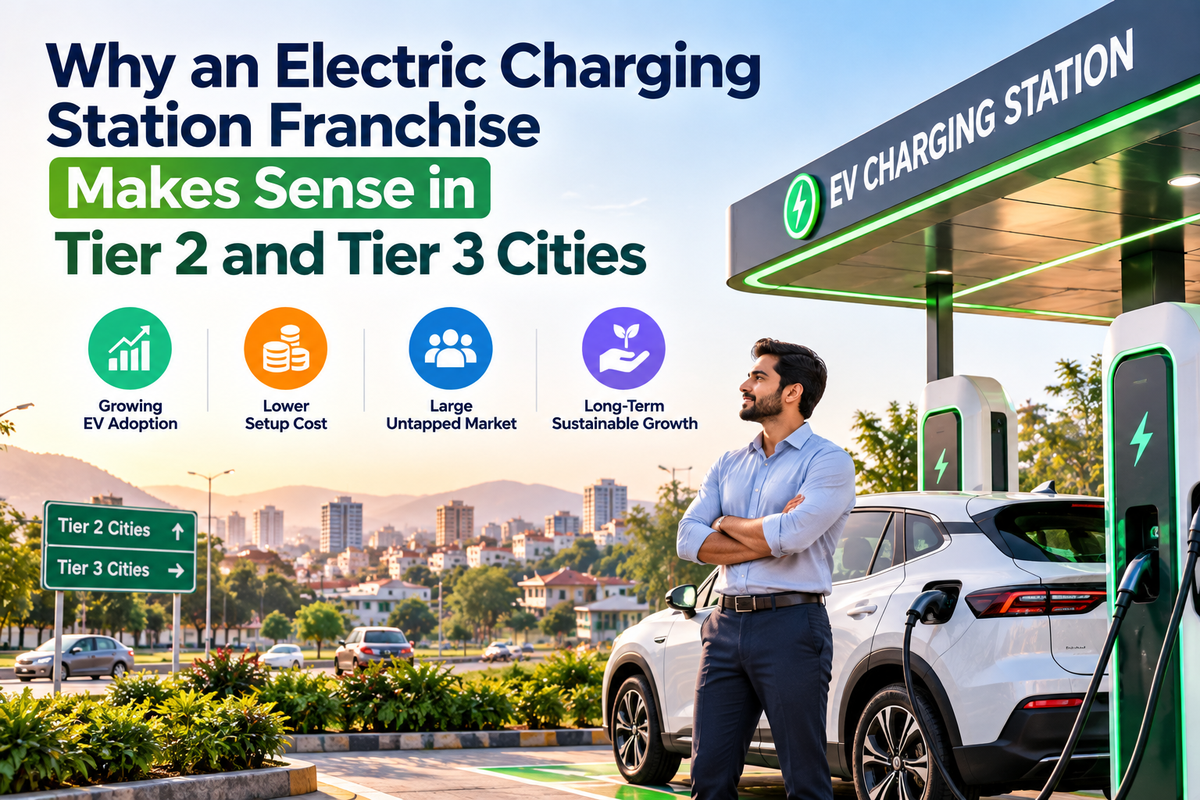
When people think of EV charging in India, they usually picture Delhi, Mumbai or Bengaluru. But some of the most promising opportunities are emerging in smaller cities. Places such as Rohtak, Panipat, Karnal, Dehradun, Ludhiana, and many others are seeing steady EV adoption, while public charging remains thin. For investors, that makes an electric charging station franchise in a Tier 2 or Tier 3 city worth serious consideration.
Electric two-wheelers and e-rickshaws have already become common in many smaller cities. Electric cars are following, helped by more affordable models, lower running costs and growing awareness. Local businesses, delivery fleets and taxi operators are also switching to EVs to cut fuel costs.
The challenge is that charging infrastructure has not spread at the same pace. Many smaller cities have only a handful of public chargers, often concentrated in one area. That creates a clear gap between demand and supply.
In metro cities, several charging networks compete for the same high-traffic locations. In Tier 2 and Tier 3 cities, an early mover can secure strong sites before the market gets crowded. Being the first reliable charger in an area often builds lasting habits among local drivers.
Land and commercial rents are typically lower outside the metros. That reduces one of the larger components of a charging station's total setup cost and can improve the payback period.
Many smaller cities sit on major highways and intercity corridors. A well-placed fast charger can serve both local EV owners and long-distance travellers who need a top-up during their journey.
E-rickshaws, electric cargo three-wheelers and last-mile delivery fleets are expanding quickly in smaller cities. These vehicles need daily, predictable charging, which can bring steady utilisation to the right station.
Running a charging station independently in a smaller city can be difficult. Technical expertise, charger servicing and software support may not be easily available locally. An electric charging station franchise solves this by connecting you to a network that already handles these pieces.
Under a FOCO (Franchise-Owned, Company-Operated) model, you invest in the station while the franchise partner manages:
This lets local entrepreneurs, property owners and business owners enter EV charging without needing a technical team of their own.
Location still matters more than anything else. Strong options include:
A good franchise partner will assess traffic patterns, local EV registrations, dwell time and available electrical load before recommending a site.
You do not always need the most powerful charger. In many smaller cities, a 40 kW or 60 kW DC charger can serve cars and commercial vehicles efficiently. Investment for a 40 kW setup typically starts around ₹10 lakh to ₹14 lakh, while larger highway hubs with 150 kW or more cost significantly more. Matching charger capacity to actual demand helps protect your returns.
The PM E-DRIVE scheme allocates ₹2,000 crore for public EV charging infrastructure across India, with support for eligible entities. Banks and NBFCs are also offering financing for charging equipment. These measures make it easier to set up an EV charging franchise in markets that were previously considered too early.
Smaller cities offer opportunity, but returns are never automatic. Earnings depend on utilisation, tariff, electricity cost and revenue-sharing terms. Ask your franchise partner for a site-specific projection, and avoid offers that promise fixed or guaranteed income.
Tier 2 and Tier 3 cities are where India's next wave of EV growth is likely to happen. Investors who move early, choose good sites and partner with a reliable network can build a valuable infrastructure asset before competition catches up.
Networks such as EarthtronEV are already expanding from Delhi-NCR and highway corridors into smaller cities through a FOCO franchise model. To see how a managed setup works, explore the EV charging franchise options available with EarthtronEV.

This post has been authored and published by one of our premium contributors, who are experts in their fields. They bring high-quality, well-researched content that adds significant value to our platform.